
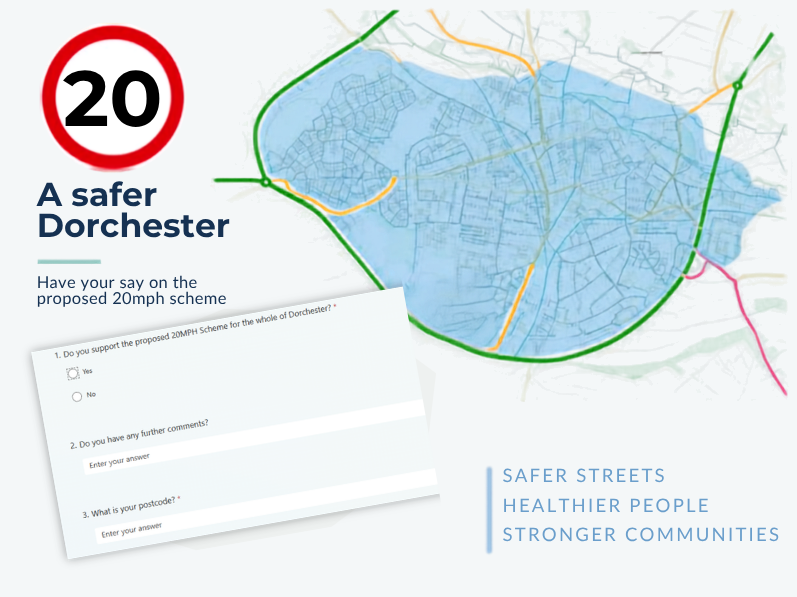

That was the view of one Dorchester resident who stopped to talk to DTAG at the Anonymous Festival on Sunday, as we once again joined Dorchester Town Council councillors to hear views on the proposed town-wide 20mph scheme.
With the consultation now in its final days, we spoke to a wide range of people about the proposal. Among the Dorchester residents who came to talk to us there was strong support – and safety was overwhelmingly the main reason.
Perhaps the simplest comment came from a nine-year-old girl:
“I want to feel safe.”
Parents repeatedly told us they don’t feel confident letting their children walk to school independently because of traffic. Young people raised similar concerns, while others described the difficulties they experience simply getting around the town.
Among the comments we heard were:
“I’d feel a lot more confident about my children walk to school.”
“It would make Dorchester feel safer for walking and cycling.”
“It’s hard to cross the road with traffic moving so fast.”
“We need calmer streets, not faster traffic.”
“I feel really unsafe using my mobility scooter on the road, but there is no room on the pavement”
For DTAG, the case for 20mph is first and foremost about making Dorchester’s streets safer for everyone – particularly children, people walking and cycling, and those with limited mobility.
The comment about the mobility scooter also highlights a particular challenge for Dorchester.
Why DTAG supports 20mph
As a historic market town, many of our streets are narrow and physically constrained. People walking, cycling, using mobility aids and driving inevitably have to share limited street space. Lower speeds can help make that shared environment safer and less intimidating for everyone.
We can’t make Dorchester’s historic streets wider – but we can make them safer and more welcoming for the different people who need to use them.
There is also encouraging evidence from elsewhere in the UK. Wales introduced a default 20mph limit on restricted roads in September 2023. Welsh Government figures show that in 2025, police-recorded collisions on roads with 20mph and 30mph limits combined were 22% lower than in 2022, the last full calendar year before the change. In the first full year following its introduction, casualties on these roads were 25% lower than in 2022.
The benefits go beyond collision statistics. Slower traffic can help create calmer, more pleasant streets and give people greater confidence to walk and cycle. For parents, that can mean giving children greater freedom to make everyday journeys independently.
Dorset Council’s own 20mph policy recognises potential benefits including improved quality of life, healthier lifestyles and encouraging walking and cycling, with schools and active school travel among the factors considered when prioritising schemes.
There were objections too. Some people were concerned about slower car journeys or felt that existing 30mph limits should remain. These concerns appeared more often among people driving into or through Dorchester.
For many of the residents we spoke to, however, the issue looked rather different. Our streets aren’t simply routes for getting vehicles from A to B. They are also places where people live, children travel to school, people walk and cycle, shop and go about their daily lives.
A 20mph limit won’t solve every transport or road-safety problem in Dorchester. But if slightly slower traffic can help prevent collisions and injuries, give children greater independence and make more people feel safe getting around their own town, we believe prioritising safety is the right choice for Dorchester.
The consultation closes on 7 September. If you haven’t responded yet, make sure your voice is heard and complete the survey.